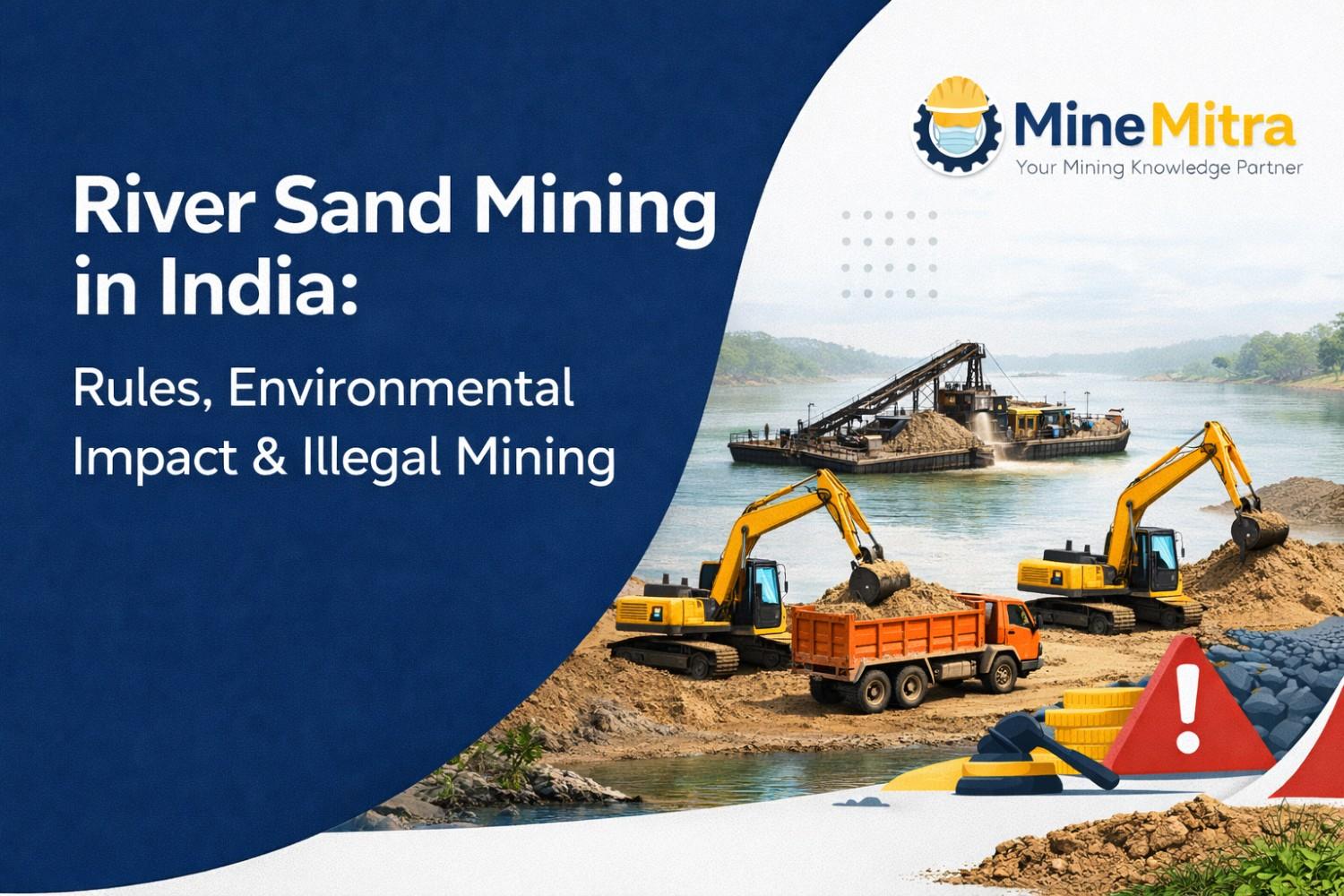
River sand mining in India has emerged as one of the most debated environmental and regulatory issues over the last two decades. Sand, although often seen as an ordinary construction material, is a strategic natural resource that directly supports infrastructure development, housing, roads, bridges, and urban expansion.
India’s rapid growth in construction and real estate has led to a massive increase in demand for river sand. Rivers such as the Ganga, Yamuna, Narmada, Tapi, Sabarmati, Godavari, and Cauvery have become primary sources of natural sand extraction. However, uncontrolled and unscientific river sand mining has resulted in serious environmental damage, legal conflicts, and widespread illegal mining activities.
River sand mining in India is no longer just a mining issue. It has become a complex challenge involving:
- Environmental protection
- Sustainable development
- State revenue
- Law and order
- Judicial intervention
This article explains what river sand mining is, why it is important, why it has become controversial, and how illegal sand mining has turned into a major enforcement problem in India.
What Is River Sand Mining?
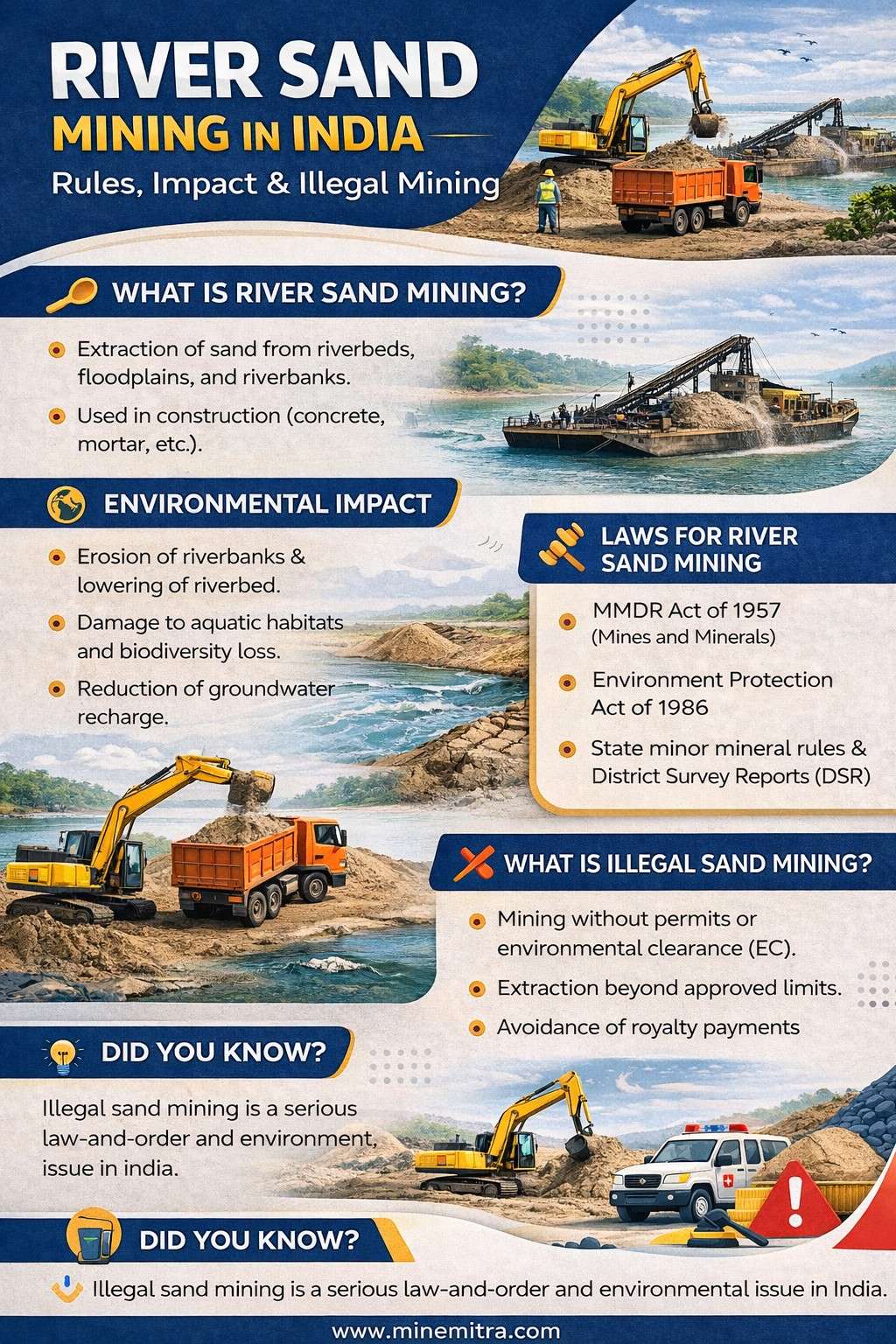
River sand mining refers to the extraction of sand from riverbeds, floodplains, and riverbanks for use in construction and industrial activities.
Sand found in riverbeds is naturally formed through:
- Weathering of rocks
- Transportation by flowing water
- Continuous erosion and deposition processes
This sand is typically:
- Well-graded
- Rounded in shape
- Free from excessive impurities
Because of these qualities, river sand is preferred over many artificial alternatives in concrete and mortar.
However, river sand mining in India is legally permitted only under regulated conditions. Any extraction beyond permitted limits or without authorization is treated as illegal sand mining.
Importance of River Sand in Construction
To understand why river sand mining in India is so widespread, it is important to understand the role of sand in construction.
Role of Sand in Concrete and Mortar
Sand acts as:
- A fine aggregate in concrete
- A binding medium in mortar
- A stabilizing component in plastering
River sand provides:
- Better workability
- Stronger bonding with cement
- Reduced cracking
This is why builders traditionally prefer river sand despite regulatory restrictions.
Infrastructure Growth and Sand Demand
India’s infrastructure boom has dramatically increased demand for sand due to:
- Housing projects
- Highway and expressway construction
- Bridges, dams, and ports
- Smart cities and urban redevelopment
As demand increased, legal supply failed to keep pace, creating a gap that illegal sand mining networks quickly exploited.
Why River Sand Mining in India Became a Crisis
River sand mining in India was once a small-scale, localized activity. Over time, it transformed into a large-scale extraction industry, often operating beyond environmental and legal limits.
Over-Extraction of Riverbeds
Unregulated sand removal leads to:
- Lowering of riverbeds
- Disturbance of natural flow patterns
- Increased erosion of riverbanks
This directly affects:
- River stability
- Flood control systems
- Adjacent agricultural land
Impact on Groundwater Levels
One of the most serious consequences of river sand mining in India is groundwater depletion.
When sand is removed:
- Natural aquifer recharge is disrupted
- Water table levels fall
- Wells and hand pumps dry up
This directly affects rural and urban water supply.
Increased Flood and Infrastructure Risk
Excessive sand mining increases:
- River velocity
- Scouring near bridge foundations
- Risk of embankment failure
Several cases in India have linked bridge damage and riverbank collapse to unscientific sand mining.
Environmental Impact of River Sand Mining in India
Environmental impact is the central reason behind strict regulation of river sand mining in India.
Ecological Damage
River ecosystems support:
- Fish breeding grounds
- Aquatic plants
- Micro-organisms essential for river health
Sand mining disrupts these ecosystems, leading to:
- Loss of biodiversity
- Decline in fish population
- Damage to aquatic habitats
River Morphology Changes
Uncontrolled sand extraction alters:
- River course
- Sediment balance
- Floodplain structure
Once disturbed, these systems take decades to recover, if recovery is possible at all.
Legal vs Illegal River Sand Mining
This distinction is extremely important.
Legal river sand mining:
- Is permitted by state authorities
- Operates under defined quantity limits
- Requires environmental clearance
- Pays royalty and taxes
Illegal sand mining:
- Operates without permits
- Exceeds approved quantities
- Occurs at night or in restricted areas
- Avoids royalty payment
A mine can be legally allotted and still engage in illegal river sand mining if it violates permit conditions.
Why Illegal Sand Mining Flourishes in India
Despite strict laws, illegal sand mining continues due to:
- High profit margins
- Limited enforcement staff
- Large river networks
- Local political pressure
- Weak monitoring mechanisms
Illegal sand mining in India often involves:
- Organized groups
- Transport permit manipulation
- Use of multiple vehicles
- Intimidation of local officials
This has transformed sand mining into a law-and-order issue, not just a regulatory violation.
Role of Demand–Supply Gap
One of the biggest drivers of illegal river sand mining in India is the gap between legal supply and market demand.
- Environmental restrictions reduce legal extraction
- Construction demand continues to rise
- Alternatives like manufactured sand face resistance
This imbalance creates an opportunity for illegal operators.
Why Courts and Tribunals Intervened
Due to large-scale damage, courts have repeatedly intervened in river sand mining matters.
Judicial intervention occurred because:
- State enforcement failed
- Environmental damage was evident
- Public interest litigation increased
This led to:
- Temporary bans
- Strict guidelines
- Monitoring by courts and tribunals
Why This Topic Matters for Exams and Policy
River sand mining in India is frequently asked in:
- State mining exams
- Environmental studies
- Administrative services interviews
Questions often focus on:
- Environmental impact
- Legal regulation
- Role of state authorities
- Difference between legal and illegal sand mining
Laws Governing River Sand Mining in India
River sand mining in India is not governed by a single law. Instead, it is regulated through a combination of central legislation, state rules, environmental laws, and judicial directions. Understanding this legal framework is essential to distinguish between legal sand mining and illegal sand mining.
Mines and Minerals (Development and Regulation) Act, 1957 (MMDR Act)
The MMDR Act, 1957 is the primary legislation governing mineral resources in India, including river sand.
Key provisions relevant to river sand mining:
- Minerals are owned by the State
- Mining can be carried out only under a valid lease or permit
- Royalty must be paid for extracted minerals
- Illegal mining attracts penalties, seizure, and prosecution
Although sand is classified as a minor mineral, the MMDR Act provides the legal backbone for regulating river sand mining in India.
State governments are empowered under this Act to frame rules for minor minerals, which directly control sand mining operations.
State Minor Mineral Rules
Each state has its own Minor Mineral Rules, framed under the MMDR Act. These rules are the most important operational laws for river sand mining in India.
State rules define:
- Grant of quarry permits and leases
- Quantity and area limits for sand extraction
- Conditions for transport and storage
- Royalty rates and payment procedure
- Powers of inspection, seizure, and compounding
Most cases of illegal river sand mining are detected and acted upon under state minor mineral rules, not directly under central law.
Environmental Protection Laws
Environmental regulation plays a decisive role in river sand mining in India.
Key environmental laws include:
- Environment (Protection) Act, 1986
- EIA Notification, 2006
- Environmental clearance guidelines for minor minerals
Environmental clearance (EC) is mandatory for sand mining beyond specified limits. Mining without EC, or violation of EC conditions, is treated as illegal sand mining.
Role of District Survey Report (DSR)
A District Survey Report (DSR) is a critical document prepared to:
- Identify sand-bearing areas
- Assess environmental sensitivity
- Define permissible mining zones
Sand mining without reference to an approved DSR is considered unsustainable and illegal. The DSR concept was introduced to ensure scientific and planned sand extraction instead of random riverbed mining.
Role of National Green Tribunal (NGT) in Sand Mining
The National Green Tribunal (NGT) has played a major role in shaping river sand mining policy in India.
Why NGT intervened:
- Large-scale environmental degradation
- Failure of state machinery
- Uncontrolled illegal sand mining
NGT orders have led to:
- Temporary bans on sand mining in several states
- Mandatory environmental clearance
- Preparation of DSRs
- Monitoring of sand mining operations
NGT’s involvement transformed river sand mining from a state-level administrative issue into a national environmental concern.
Supreme Court Guidelines on Sand Mining
The Supreme Court of India has also issued landmark directions related to sand mining.
Key principles established:
- Environmental clearance is mandatory even for small sand mining projects
- Sustainable mining practices must be followed
- States are responsible for preventing illegal sand mining
These judgments significantly tightened regulation of river sand mining in India.
Why River Sand Mining Is Banned or Restricted in Many States
Several states have imposed partial or complete bans on river sand mining due to:
- Severe environmental damage
- Riverbank erosion and flooding
- Groundwater depletion
- Failure of regulatory enforcement
Instead of outright permission, many states now allow:
- Limited extraction
- Seasonal mining
- Auction-based sand mining
- Government-controlled mining
These restrictions aim to balance development needs with environmental protection.
Legal Process for Grant of Sand Mining Permission
Legal river sand mining in India generally requires:
- Identification of sand-bearing area through DSR
- Environmental clearance (if applicable)
- Grant of lease or permit by state authority
- Payment of royalty and fees
- Compliance with mining and environmental conditions
Any deviation at any stage results in illegal sand mining, even if a permit exists.
Difference Between Regulatory Violation and Criminal Offence
Not all sand mining violations are treated equally.
Regulatory violations include:
- Minor excess extraction
- Procedural lapses
- Documentation errors
These may be handled through penalties or compounding.
Criminal offences include:
- Mining without any permit
- Organized illegal sand mining
- Repeated violations
- Environmental destruction
Such cases attract seizure, FIR, and prosecution.
Why Enforcement Remains Difficult Despite Laws
Despite a strong legal framework, enforcement of river sand mining in India remains challenging due to:
- Large river networks
- Limited inspection staff
- Local resistance
- High economic value of sand
This gap between law and enforcement explains the persistence of illegal sand mining.
Illegal River Sand Mining in India – Ground Reality
Despite strict laws and judicial monitoring, illegal river sand mining in India continues on a large scale. This is primarily because sand is a high-demand, high-profit resource with relatively low operational costs.
Illegal sand mining typically occurs:
- During night hours
- In restricted or banned river stretches
- Beyond permitted quantities
- Without environmental clearance
In many regions, illegal sand mining has become organized and systematic, involving multiple actors such as transporters, local intermediaries, and illegal operators.
Common Methods Used in Illegal Sand Mining
Illegal river sand mining in India does not follow a single pattern. Some common practices include:
Mining Without Any Permit
Sand is extracted directly from riverbeds without any lease, permit, or environmental approval.
Excess Extraction by Legal Permit Holders
Even legally permitted operators often exceed:
- Approved quantity
- Permitted depth
- Designated mining area
This turns a legal operation into illegal sand mining.
Illegal Transportation of Sand
Sand is transported:
- Without valid transit passes
- Using fake or reused permits
- In overloaded vehicles
Transport violations are among the most frequently detected offences in sand mining enforcement.
Penalties for Illegal River Sand Mining in India
Penalties for illegal sand mining vary depending on the severity of the offence and applicable state rules.
Monetary Penalties
These may include:
- Recovery of unpaid royalty
- Additional penalty (often multiple times the royalty)
- Environmental compensation
Seizure of Minerals, Vehicles, and Machinery
Authorities may seize:
- Illegally mined sand
- Vehicles used for transportation
- Excavators or machinery used for mining
Seizure acts as a strong deterrent against illegal sand mining.
Criminal Prosecution
Serious or repeated cases may result in:
- Registration of FIR
- Criminal proceedings
- Imprisonment and fines
Criminal action is usually taken when illegal sand mining causes significant environmental or public harm.
Role of State Authorities in Controlling Sand Mining
Control of river sand mining in India is primarily a state responsibility.
Key authorities involved include:
- Royalty Inspectors
- Mining Officers and Geologists
- District administration
- Police Department
- Environmental authorities
Role of Royalty Inspectors
Royalty Inspectors play a critical role by:
- Conducting field inspections
- Verifying permits and quantities
- Checking transit passes
- Detecting illegal extraction and transport
Most illegal sand mining cases are first detected at this ground-level inspection stage.
Why Illegal Sand Mining Is Difficult to Control
Several factors make enforcement challenging:
- Extensive river networks
- Limited manpower
- High construction demand
- Local economic dependence on sand
- Legal and procedural delays
As a result, even strong laws struggle to fully eliminate illegal sand mining in India.
Alternatives to River Sand – Is the Transition Possible?
Due to environmental concerns, alternatives to river sand are increasingly promoted.
Manufactured Sand (M-Sand)
M-sand is produced by crushing hard rock and offers:
- Controlled quality
- Reduced environmental impact
- Consistent supply
However, challenges include:
- Higher cost perception
- Resistance from traditional builders
- Limited awareness in rural areas
Other Alternatives
- Quarry dust
- Recycled construction waste
While alternatives exist, large-scale transition remains slow, keeping pressure on river sand resources.
Conclusion
River sand mining in India is a critical issue balancing development needs with environmental protection. While sand is essential for infrastructure growth, uncontrolled and illegal extraction has caused serious ecological and social damage.
Strong laws such as the MMDR Act, state minor mineral rules, and environmental regulations exist, but effective control depends on:
- Field-level enforcement
- Scientific planning
- Use of sustainable alternatives
- Public and administrative awareness
For policymakers, administrators, and aspirants, understanding river sand mining from a legal, environmental, and practical perspective is essential for sustainable resource management.
Is river sand mining completely banned in India?
No. River sand mining is regulated, not completely banned. It is allowed under strict conditions.
Why is illegal sand mining treated seriously?
Because it causes environmental damage, groundwater depletion, and revenue loss.
Who controls sand mining at the ground level?
State mining departments and Royalty Inspectors are primarily responsible.
Can vehicles be seized in illegal sand mining cases?
Yes. Vehicles and machinery involved in illegal sand mining can be seized as per state rules.
About the Author
Navin Solanki is a Mining Engineer with over 5 years of practical experience in the Indian mining sector. He focuses on mining operations, geology, environmental studies, and regulatory topics in India. [Read More]