Understand the environmental impact of mining in India, including land degradation, water pollution, biodiversity loss, and real examples from Indian mining regions.
Mining is one of the most important industrial activities supporting India’s economic growth. Minerals extracted from the earth form the foundation of infrastructure, energy production, manufacturing, and technological development. Coal fuels power plants, iron ore supports steel production, limestone is essential for cement, and sand drives construction. Without mining, modern society cannot function.
However, alongside its economic importance, mining has also emerged as one of the most environmentally disruptive human activities. The environmental impact of mining in India has become a critical concern due to the scale, intensity, and geographic spread of mining operations across the country. River sand Mining in india is also important factor playing major role in environment.
India hosts a wide variety of mineral resources and mining environments — coalfields in Jharkhand and Chhattisgarh, iron ore belts in Odisha and Karnataka, limestone quarries in Rajasthan and Gujarat, bauxite plateaus in central India, and river sand mining along almost every major river system. Each of these mining activities interacts with the environment in different ways, but the cumulative environmental pressure is significant.
The environmental impact of mining in India is no longer limited to isolated mine sites. It affects land stability, water availability, air quality, forest ecosystems, biodiversity, and human settlements. In many regions, environmental degradation caused by mining has led to long-term ecological damage, social conflict, and legal intervention by courts and tribunals.
This pillar article provides a comprehensive, in-depth explanation of how mining affects the environment in India, supported by real examples from different mining regions. Instead of treating mining impacts as abstract concepts, this article explains why these impacts occur, how they manifest on the ground, and why regulation and mitigation are essential.
Mining and the Indian Environmental Context
India’s environmental vulnerability makes mining impacts more severe compared to many other countries. Several factors amplify the environmental impact of mining in India:
- High population density near mining areas
- Dependence on rivers and groundwater for agriculture and drinking water
- Ecologically sensitive regions overlapping with mineral belts
- Forest-dependent tribal and rural communities
Mining often takes place in forest regions, river catchments, and hilly terrain, where ecosystems are already fragile. When large-scale excavation, blasting, and material handling are introduced into these landscapes, environmental stress increases rapidly.
In states such as Odisha, Chhattisgarh, Jharkhand, Madhya Pradesh, Rajasthan, Gujarat, Karnataka, and Telangana, mining activities coexist with agriculture, wildlife habitats, and human settlements. As a result, the effects of mining extend far beyond the mine boundary.
The environmental impact of mining in India therefore needs to be understood not just as a technical issue, but as a land-use and governance challenge.
Types of Mining Practiced in India and Their Environmental Footprint
Different mining methods produce different environmental impacts. Understanding these methods is essential to understand the effects of mining on the environment in India.
Open Cast (Surface) Mining
Open cast mining is the most common mining method in India, especially for coal, limestone, iron ore, and bauxite.
Environmental characteristics:
- Large-scale removal of overburden
- Permanent alteration of landforms
- High dust generation
- Extensive vegetation clearance
Open cast mining causes severe land degradation, making it one of the biggest contributors to environmental problems due to mining in India.
Example: Coal mining in Jharia and Talcher coalfields has resulted in large tracts of disturbed land and surface subsidence.
Underground Mining
Underground mining is used for coal, metallic minerals, and some base metals.
Environmental characteristics:
- Lower surface disturbance compared to open cast mining
- Risk of land subsidence
- Acid mine drainage
- Groundwater contamination
While underground mining appears less destructive on the surface, its long-term impact on groundwater and land stability can be significant.
Quarrying and Minor Mineral Mining
Quarrying for stone, limestone, and sand is widespread across India.
Environmental characteristics:
- Shallow excavation over large areas
- Unregulated expansion
- High interaction with rivers and agricultural land
River sand mining is a major contributor to environmental degradation, affecting river morphology and groundwater recharge.
Why Mining Has a High Environmental Impact
Mining is fundamentally different from many other industries because it involves removal of natural material from the earth. Once minerals are extracted, they cannot be replaced within a human timescale.
The environmental impact of mining in India arises from several unavoidable processes:
- Excavation of land and rock
- Removal of vegetation and soil cover
- Generation of waste material (overburden, tailings)
- Use of explosives and heavy machinery
- Transportation of large quantities of material
Each stage of the mining lifecycle creates environmental stress.
Scale of Mining Activities in India
India is one of the world’s leading producers of coal, iron ore, bauxite, limestone, manganese, and chromite. Thousands of large and small mines operate across the country.
Key implications:
- Mining impacts are geographically widespread
- Environmental monitoring becomes difficult
- Cumulative impact is often underestimated
Small mines, although individually limited, collectively contribute heavily to environmental issues due to mining, especially in minor mineral sectors.
Environmental Impact of Mining in India – A Holistic Overview
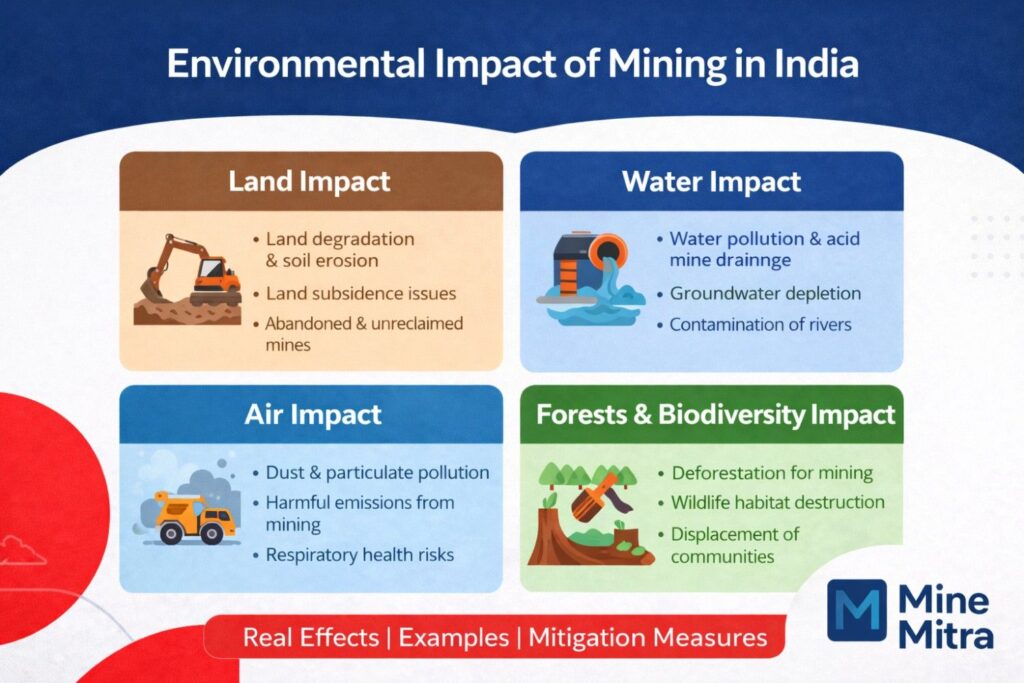
The environmental impact of mining in India can be broadly categorized into the following areas:
- Impact on land and soil
- Impact on water resources
- Impact on air quality
- Impact on forests and biodiversity
- Impact on human health and settlements
Each of these will be covered in detail in later parts of this pillar article. At this stage, it is important to understand that these impacts are interconnected.
For example:
- Land degradation increases soil erosion, which pollutes rivers
- Water pollution affects agriculture and drinking water
- Forest loss leads to biodiversity decline and climate imbalance
Mining therefore creates a chain reaction of environmental damage.
Real Examples Highlighting the Environmental Impact of Mining in India
Coal Mining in Jharkhand and Chhattisgarh
Coal mining has caused:
- Large-scale deforestation
- Groundwater contamination
- Land subsidence
In many coalfields, abandoned mines remain unreclaimed, posing long-term environmental risks.
Iron Ore Mining in Odisha and Karnataka
Iron ore mining has resulted in:
- Severe land degradation
- Dust pollution affecting nearby villages
- Forest destruction
Judicial interventions in Karnataka were triggered by uncontrolled mining and environmental violations.
Limestone Quarrying in Rajasthan
Limestone mining has affected:
- Agricultural land
- Groundwater availability
- Local ecosystems
In arid regions, the impact of mining on water resources is particularly severe.
Environmental Impact vs Economic Benefits – The Core Conflict
Mining creates jobs, revenue, and infrastructure. However, environmental damage often:
- Reduces agricultural productivity
- Increases health costs
- Creates long-term land liability
The environmental impact of mining in India therefore raises a critical policy question:
How can economic development be balanced with environmental protection?
This question lies at the heart of mining regulation, environmental clearance, and judicial oversight in India.
Why Environmental Impact Assessment Is Crucial
Environmental Impact Assessment (EIA) is designed to:
- Predict environmental damage before mining starts
- Impose safeguards and conditions
- Prevent irreversible harm
However, weak implementation of EIA has allowed several mining projects to operate with inadequate environmental safeguards, increasing environmental damage.
Importance of Understanding This Topic for Policy, Exams, and Governance
The environmental impact of mining in India is a core topic in:
- Environmental studies
- Mining and geology exams
- Administrative services interviews
- Policy and governance discussions
Questions increasingly focus on:
- Sustainable mining
- Environmental regulation
- Real-world consequences of mining
A strong conceptual understanding gives aspirants and professionals a clear advantage.
Impact of Mining on Land and Soil in India
One of the most visible and irreversible consequences of mining is land degradation. The environmental impact of mining in India is most clearly reflected in the way mining operations permanently alter landforms, soil structure, and surface stability.
Mining requires the removal of vegetation, topsoil, and rock layers to access mineral deposits. Once disturbed, land rarely returns to its original condition, especially when reclamation measures are weak or absent.
Land Degradation Due to Mining Activities
Land degradation refers to the loss of productive capacity of land caused by physical disturbance, chemical contamination, and erosion. In India, mining has emerged as a major contributor to land degradation, particularly in mineral-rich states.
Major causes of land degradation due to mining include:
- Removal of fertile topsoil
- Dumping of overburden and waste material
- Formation of deep pits and voids
- Unplanned expansion of mining areas
Open cast mining is especially destructive because it involves complete stripping of surface layers over large areas.
Real Example: Coal Mining in Jharkhand
Coal mining in regions such as Dhanbad and Bokaro has resulted in thousands of hectares of degraded land. Abandoned open pits, unstable dumps, and subsidence zones have rendered land unsuitable for agriculture or settlement.
Soil Erosion and Loss of Fertility
Soil is a critical natural resource that supports agriculture, vegetation, and ecosystems. Mining disrupts soil in several ways:
- Topsoil removal eliminates nutrients essential for plant growth
- Exposure of loose soil increases erosion by wind and water
- Compaction by heavy machinery reduces soil permeability
In mining regions, rainfall washes loose soil into nearby rivers and streams, increasing sediment load and reducing water quality.
Effects of soil erosion caused by mining:
- Decline in agricultural productivity
- Increased siltation of water bodies
- Loss of vegetation cover
The effects of mining on soil fertility are often long-term, and recovery may take decades even with rehabilitation efforts.
Overburden Dumps and Waste Rock Disposal
Mining generates massive quantities of waste material known as overburden. Improper disposal of overburden is a major environmental problem in India.
Environmental issues associated with overburden dumps:
- Occupation of large land areas
- Instability and slope failure
- Dust generation
- Leaching of toxic substances
Unstabilized dumps are highly vulnerable to erosion, especially during monsoon seasons.
Real Example: Iron Ore Mining in Odisha
In iron ore belts of Odisha, overburden dumps have expanded rapidly due to intensive mining. Poorly managed dumps have caused slope failures, dust pollution, and contamination of nearby agricultural land.
Land Subsidence in Mining Areas
Land subsidence is a serious geological hazard associated with underground mining. It occurs when underground voids created by mineral extraction collapse, causing the surface to sink.
Causes of land subsidence:
- Uncontrolled underground excavation
- Poor roof support
- Abandoned mine workings
Environmental and social consequences:
- Damage to houses and infrastructure
- Cracks in roads and buildings
- Risk to human safety
Real Example: Jharia Coalfield
The Jharia coalfield in Jharkhand is a classic example where underground coal mining has led to extensive subsidence, surface fires, and displacement of local communities. Land subsidence not only damages the physical environment but also creates long-term rehabilitation challenges.
Abandoned Mines and Legacy Environmental Damage
One of the most neglected aspects of mining in India is the issue of abandoned and orphaned mines. These mines are left without proper closure or reclamation.
Environmental risks posed by abandoned mines:
- Open pits filled with contaminated water
- Unstable ground conditions
- Source of dust and erosion
- Long-term land unusability
Abandoned mines continue to cause environmental damage long after mining operations have ceased, highlighting the importance of effective mine closure planning.
Impact on Agricultural Land
Mining often takes place near or within agricultural regions. The conversion of farmland into mining land results in:
- Permanent loss of cultivable land
- Reduced food production
- Soil contamination by heavy metals
Dust from mining operations settles on crops, reducing photosynthesis and crop yield.
Real Example: Limestone Mining in Rajasthan
In limestone mining regions of Rajasthan, agricultural productivity has declined due to dust deposition, groundwater depletion, and land degradation caused by quarrying activities.
Cumulative Impact of Mining on Land Resources
While individual mines may occupy limited areas, the cumulative impact of multiple mining operations is significant.
Cumulative land impacts include:
- Fragmentation of landscapes
- Loss of ecological connectivity
- Increased vulnerability to erosion and desertification
In India, cumulative impact assessment is often inadequate, leading to underestimation of environmental damage.
Why Land Reclamation Remains Weak in India
Although mine reclamation is mandatory under environmental laws, implementation remains weak due to:
- Inadequate financial provisions
- Poor monitoring and enforcement
- Lack of technical expertise
As a result, large areas of mined land remain unreclaimed, contributing to ongoing environmental degradation.
Significance of Land Impact in the Environmental Impact of Mining in India
The impact of mining on land is the starting point of environmental degradation. Once land is damaged:
- Soil erosion increases
- Water pollution intensifies
- Vegetation loss accelerates
This makes land degradation a central component of the environmental impact of mining in India and a key focus area for sustainable mining practices.
Impact of Mining on Water Resources in India
Water resources are among the most severely affected components of the environment due to mining activities. The environmental impact of mining in India becomes particularly critical when it interferes with rivers, groundwater systems, lakes, and wetlands, which are essential for drinking water, agriculture, and ecosystems.
Mining alters both the quantity and quality of water, often in ways that are difficult to reverse.
Groundwater Depletion Due to Mining
Mining operations require large volumes of water for:
- Mineral processing
- Dust suppression
- Drilling and blasting
- Domestic use in mining colonies
At the same time, excavation activities intercept natural aquifers, leading to uncontrolled groundwater drainage.
How mining causes groundwater depletion:
- Continuous pumping from mine pits
- Lowering of water table due to deep excavation
- Disruption of recharge zones
In many mining regions, wells and hand pumps have dried up permanently after the start of mining operations.
Real Example: Coal Mining in Chhattisgarh
In coal mining areas of Chhattisgarh, groundwater levels have declined significantly due to continuous dewatering of open cast mines. Nearby villages have experienced water scarcity, forcing dependence on tanker supply.
Pollution of Surface Water Bodies
Mining affects rivers, streams, and lakes through direct discharge and indirect runoff.
Major sources of water pollution from mining:
- Mine drainage water
- Runoff from overburden dumps
- Discharge of mineral processing effluents
- Sediment-laden stormwater
Suspended solids increase turbidity, reducing light penetration and harming aquatic life.
Acid Mine Drainage (AMD)
Acid Mine Drainage is one of the most dangerous and long-lasting impacts of mining on water resources.
What is Acid Mine Drainage?
When sulfide minerals exposed during mining react with air and water, they produce sulfuric acid. This acidic water dissolves heavy metals and flows into nearby water bodies.
Environmental consequences of AMD:
- Severe water acidity
- Toxic metal contamination
- Death of aquatic organisms
- Long-term river pollution
Real Example: Abandoned Coal Mines in Eastern India
Several abandoned coal mines in eastern India continue to generate acidic drainage years after closure, contaminating local streams and groundwater. Once initiated, AMD can persist for decades or even centuries, making it a serious legacy issue.
Impact of Mining on Rivers
Rivers are particularly vulnerable to mining-related activities, especially sand mining and quarrying near riverbanks.
Effects of mining on river systems:
- Alteration of riverbed morphology
- Increased sediment load
- Reduced water retention capacity
- Damage to riverbanks
Unregulated river sand mining accelerates erosion and reduces groundwater recharge along river corridors.
Real Example: Sand Mining in the Ganga and Yamuna Basins
Excessive sand extraction has caused riverbed lowering and bank erosion in several stretches, affecting both river ecology and nearby settlements.
Heavy Metal Contamination of Water
Mining releases heavy metals such as:
- Iron
- Manganese
- Lead
- Cadmium
- Mercury
These metals enter water bodies through leaching and runoff.
Environmental and health risks:
- Bioaccumulation in aquatic organisms
- Contamination of drinking water sources
- Long-term health effects in humans
Once heavy metals enter water systems, natural purification is extremely slow, making contamination persistent.
Impact on Irrigation and Agriculture
Water pollution and depletion caused by mining directly affect agriculture.
Consequences for farming communities:
- Reduced availability of irrigation water
- Soil contamination through polluted water
- Decline in crop yield and quality
Farmers near mining areas often face dual stress — land degradation and water scarcity.
Mining-Induced Flooding and Waterlogging
In some cases, mining alters natural drainage patterns, leading to:
- Flooding during monsoons
- Waterlogging of low-lying areas
- Damage to crops and infrastructure
Poorly planned mine pits and waste dumps obstruct natural water flow, increasing flood risk.
Cumulative Impact on Water Resources
The cumulative impact of multiple mining operations within a river basin is often underestimated.
Cumulative water impacts include:
- Progressive groundwater decline
- Basin-wide pollution
- Reduced resilience to droughts
In India, basin-level water impact assessment is still weak, allowing mining projects to operate without understanding long-term consequences.
Why Water Impact Is Central to the Environmental Impact of Mining in India
Water connects ecosystems, agriculture, and human settlements. Damage to water resources amplifies every other environmental impact of mining.
Once water systems are degraded:
- Ecosystem recovery slows
- Human health risks increase
- Social conflict intensifies
This makes water impact one of the most critical dimensions of the environmental impact of mining in India.
Impact of Mining on Air Quality in India
Air pollution is one of the most widespread yet underestimated consequences of mining. The environmental impact of mining in India is clearly visible in mining regions where dust, particulate matter, and gaseous emissions continuously degrade air quality.
Mining affects air quality at every stage:
- Drilling and blasting
- Excavation and loading
- Crushing and screening
- Transportation of minerals
Major air pollutants generated by mining:
- Suspended particulate matter (SPM)
- PM10 and PM2.5 dust particles
- Sulphur dioxide and nitrogen oxides (from diesel equipment)
Open cast mining, in particular, releases large volumes of fine dust, which travels far beyond the mine boundary.
Real Example: Iron Ore Mining in Karnataka
In mining districts such as Bellary, iron ore dust has caused chronic air pollution, affecting nearby villages. Dust deposition on houses, crops, and water sources has led to respiratory problems and reduced agricultural productivity.
Health Impacts of Mining-Related Air Pollution
Poor air quality in mining regions directly affects human health.
Common health issues observed:
- Respiratory diseases (asthma, bronchitis, silicosis)
- Eye and skin irritation
- Reduced lung function in children and elderly
Fine particulate matter penetrates deep into the lungs, making mining-related air pollution a serious public health concern.
Impact of Mining on Forests in India
Forests and mineral resources often overlap geographically. As a result, mining has become a major driver of deforestation and forest fragmentation in India.
How mining affects forests:
- Clearing of forest land for mine pits
- Construction of roads, railways, and infrastructure
- Dumping of overburden on forested slopes
Mining leads to permanent loss of forest cover, especially in tribal and ecologically sensitive regions.
Real Example: Bauxite Mining in Central India
Bauxite mining on forested plateaus in Odisha and Chhattisgarh has resulted in large-scale forest loss, disrupting local ecosystems and traditional livelihoods.
Loss of Biodiversity Due to Mining
Forests support diverse plant and animal species. When mining destroys forest habitats, biodiversity loss becomes inevitable.
Impacts on biodiversity include:
- Destruction of wildlife habitats
- Disruption of migration corridors
- Decline in species population
- Increased human–wildlife conflict
Mining fragments landscapes, isolating wildlife populations and reducing genetic diversity.
Impact on Wildlife and Protected Areas
Mining near wildlife sanctuaries and protected areas intensifies environmental stress.
Mining-related threats to wildlife:
- Noise from blasting and machinery
- Habitat encroachment
- Pollution of water sources used by animals
Even mining outside protected areas can affect wildlife due to edge effects and ecosystem connectivity loss.
Impact on Tribal and Forest-Dependent Communities
Mining-induced environmental degradation has a direct social dimension. Many mining regions are home to tribal and forest-dependent communities.
Consequences for local communities:
- Loss of forest-based livelihoods
- Displacement and resettlement
- Health issues due to pollution
- Cultural disruption
Environmental degradation and social displacement often occur together, making mining impacts both ecological and human.
Cumulative Environmental Impact of Mining
When air, land, water, and forest impacts are combined, the cumulative environmental impact of mining in India becomes severe.
Cumulative effects include:
- Decline in ecosystem services
- Increased vulnerability to climate change
- Long-term land and water insecurity
Individual project assessments often fail to capture this cumulative damage, leading to under-regulation.
Environmental Regulations Addressing Mining Impacts
India has several laws to regulate mining-related environmental damage, including:
- Environmental Impact Assessment requirements
- Forest conservation provisions
- Pollution control standards
However, enforcement gaps allow environmental degradation to continue in many regions.
Importance of Sustainable Mining Practices
Sustainable mining aims to reduce environmental damage while allowing resource extraction.
Key principles include:
- Minimizing land disturbance
- Efficient water management
- Dust and emission control
- Progressive reclamation
Without sustainability, mining becomes an irreversible environmental burden.
Why Environmental Impact of Mining in India Requires Urgent Attention
The environmental impact of mining in India is no longer localized. It affects:
- Food security
- Water security
- Public health
- Biodiversity conservation
Unchecked mining threatens long-term development goals and ecological balance.
Environmental Regulation of Mining Activities in India
India has developed a comprehensive legal framework to control the environmental impact of mining. However, the effectiveness of these regulations depends largely on implementation and monitoring.
Key regulatory mechanisms include:
- Environmental Impact Assessment (EIA) before mine approval
- Environmental Clearance (EC) conditions
- Forest Clearance for diversion of forest land
- Consent to Establish and Operate from Pollution Control Boards
Mining projects are required to assess potential environmental damage in advance and adopt mitigation measures as part of the approval process.
Despite this framework, gaps in enforcement have allowed environmental degradation to continue in several mining regions.
Role of Environmental Impact Assessment (EIA)
Environmental Impact Assessment is intended to:
- Identify environmental risks before mining begins
- Predict impacts on land, water, air, and biodiversity
- Suggest mitigation and monitoring measures
In practice, EIA reports often suffer from:
- Inadequate baseline data
- Underestimation of cumulative impacts
- Limited public participation
Weak EIAs reduce the ability of authorities to prevent environmental damage, increasing the environmental impact of mining in India.
Mine Reclamation and Land Rehabilitation
Mine reclamation is a critical step in reducing long-term environmental damage.
Objectives of mine reclamation:
- Stabilize disturbed land
- Restore soil fertility
- Re-establish vegetation cover
- Prevent erosion and water pollution
Reclamation techniques include:
- Backfilling of mine pits
- Grading and stabilization of overburden dumps
- Topsoil replacement
- Plantation of native species
However, reclamation in India often remains partial or delayed, leaving large areas environmentally degraded.
Mine Closure Planning and Environmental Protection
Mine closure planning aims to ensure that environmental responsibility does not end when mining stops.
Key components of mine closure include:
- Physical stabilization of mine workings
- Treatment of contaminated water
- Safe disposal of waste material
- Post-closure monitoring
Poorly planned mine closure leads to legacy environmental issues, including abandoned pits, contaminated water bodies, and unsafe land conditions.
Pollution Control Measures in Mining
Pollution control is essential to reduce air and water impacts.
Common pollution control practices include:
- Water spraying to control dust
- Covered conveyor belts and transport vehicles
- Effluent treatment plants
- Sedimentation ponds for runoff control
When properly implemented, these measures significantly reduce pollution. However, non-compliance remains common in small and medium-scale mining operations.
Role of Technology in Reducing Environmental Impact
Modern technology can reduce the environmental impact of mining in India.
Technological interventions include:
- Remote sensing for monitoring land disturbance
- GPS tracking of mineral transport
- Automated dust suppression systems
- Mine planning software to minimize waste
Technology improves transparency and helps authorities detect environmental violations more effectively.
Community Participation and Environmental Governance
Local communities are often the first to experience environmental damage caused by mining.
Importance of community involvement:
- Early detection of environmental issues
- Improved accountability of mining operators
- Better rehabilitation outcomes
Public hearings and grievance mechanisms are essential tools, but they are often underutilized or poorly conducted.
Sustainable Mining as the Way Forward
Sustainable mining seeks to balance economic development with environmental protection.
Principles of sustainable mining include:
- Resource efficiency
- Minimal environmental footprint
- Progressive reclamation
- Long-term land use planning
Adopting sustainable mining practices reduces conflict, improves social acceptance, and lowers long-term environmental costs.
Environmental Impact of Mining in India: A Long-Term Perspective
The environmental impact of mining in India extends beyond the operational life of a mine. Land degradation, water contamination, and biodiversity loss can persist for decades if not addressed properly.
Effective regulation, scientific planning, and strict enforcement are essential to ensure that mining does not compromise environmental sustainability and human well-being.
Conclusion
Mining is indispensable for India’s development, but its environmental costs cannot be ignored. The environmental impact of mining in India is evident in degraded land, polluted water, poor air quality, forest loss, and biodiversity decline.
While laws and regulations exist, the real challenge lies in implementation, monitoring, and accountability. Strengthening environmental governance, improving mine planning, enforcing reclamation, and promoting sustainable mining practices are critical for reducing environmental damage.
Balancing mineral extraction with environmental protection is not optional—it is essential for India’s long-term ecological and economic stability.
About the Author
Navin Solanki is a Mining Engineer with over 5 years of practical experience in the Indian mining sector. He focuses on mining operations, geology, environmental studies, and regulatory topics in India. [Read More]