Drilling and blasting form the backbone of modern mining. Whether it’s a large opencast metal mine, a limestone quarry, a coal overburden operation, or an underground hard-rock mine, almost every ton of rock produced today is broken using drilling and blasting.
What is Drilling and Blasting in Mining?
Drilling & Blasting is a mechanical + explosive process used to break rock into a workable size.
The sequence is simple:
- Drill holes in the rock
- Fill them with explosives
- Initiate them safely
- The blast fractures the rock
- Load → Haul → Crush → Process
Mining without drilling and blasting is impossible in hard rock. Even in soft rock, drilling & blasting reduces cost and improves fragmentation.
Importance of Drilling & Blasting
Mining productivity depends directly on drill & blast quality:
- Better fragmentation → faster loading
- Less oversized → better productivity
- Controlled vibration → safer blasting
- Correct drilling → reduced explosive consumption
- Proper spacing → uniform breakage
- Ideal burden → safe energy release
Even a small drilling error can destroy an entire blast pattern.
Types of Drilling Used in Mining
A) Rotary Drilling
Uses rotation to cut rock.
Used in:
- Large opencast metal mines
- Soft formations
- 150–350 mm holes
Advantages:
- High rate of penetration
- Very large diameter holes
B) Percussive Drilling (Hammering Action)
This type breaks rock by repeated hammering.
Types:
- Top Hammer (TH)
- Good for short holes
- Used in small quarries
- Down-The-Hole (DTH)
- Hammer is directly behind bit
- Deep, straight holes
- Most popular in limestone & stone quarries
Why DTH is important?
✔ Minimal deviation
✔ High accuracy
✔ Uniform fragmentation
C) Jumbo Drilling (Underground)
Used for tunneling & development headings.
Comes with 1–3 booms, allowing multiple holes in one setup.
Applications:
- Drivage
- Shaft sinking
- Long-hole blasting
- Production stoping
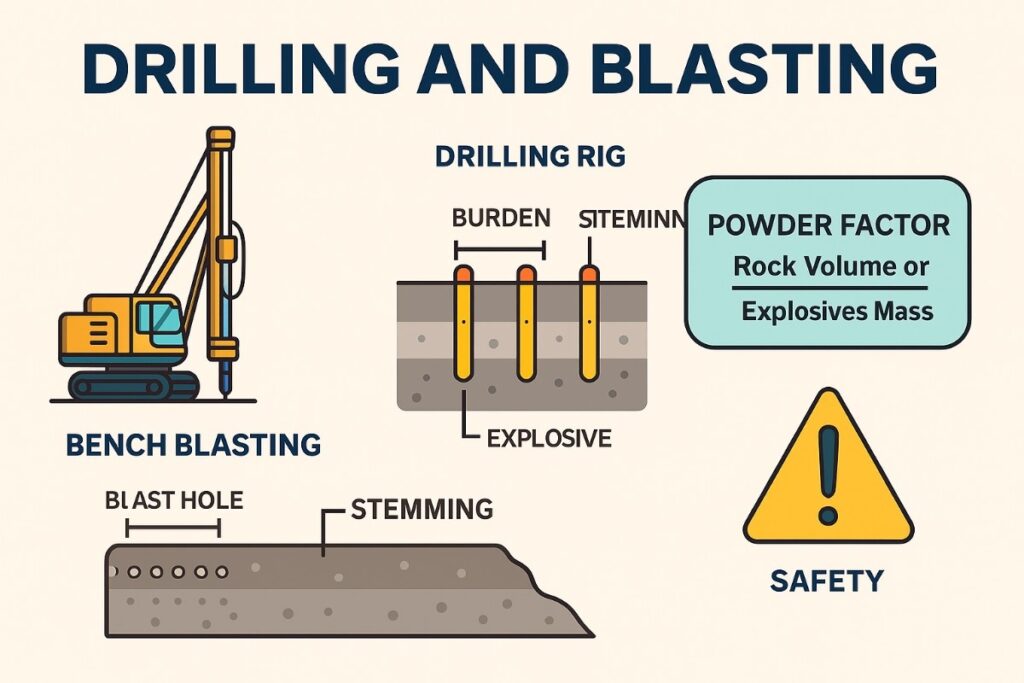
Key Drilling Parameters (Exam + Field)
| Parameter | Meaning |
|---|---|
| Burden (B) | Free face se first hole tak distance |
| Spacing (S) | Hole-to-hole distance |
| Bench Height (H) | Floor to free face height |
| Sub-Drilling | Extra depth for full toe breakage |
| Stemming | Inert material above explosive column |
| Charge per Hole | PQ × Density × Hole Volume |
Typical Ratios
- Spacing = 1.2–1.5 × Burden
- Stemming = 0.7 × Burden
- Sub-drilling = 10–30% of hole depth
Explosives Used in Mining
1. ANFO (Ammonium Nitrate + Fuel Oil)
- Most common
- Cheap
- Easy to load
- Not water-resistant
Used in:
- Dry holes
- Bulk blasting
- Surface mines
2. Slurry Explosives
- Water-resistant
- Good for wet holes
3. Emulsion Explosives
- High velocity of detonation (VOD)
- Best for hard rock
- Very good water resistance
Used in:
- Granite mines
- Metal mines
- Underground charging
4. Cartridge Explosives
- Gelatin / permitted explosives
- Underground fiery mines
- Small diameter holes
Initiation Systems
A) Detonators
- Electric
- Non-electric (NONEL) → industry standard
B) Detonating Cord (Det Cord)
Used for surface connections.
C) Delay Systems
- Short delay
- Long delay
- Electronic delay → highest accuracy
Delays help in:
✔ Fragmentation
✔ Vibration control
✔ Reducing flyrock
Blasting Patterns
Surface Mines
- Square
- Staggered (most efficient)
- Line drilling
- Pre-splitting
- Buffer blasting
Underground Mines
- Burn Cut
- V-Cut
- Fan Cut
- Pyramid Cut
- Parallel Cut
Blasting Problems & Their Solutions
| Problem | Cause | Solution |
|---|---|---|
| Flyrock | Overcharging | Reduce charge, increase stemming |
| Overbreak | Excess energy | Controlled delay & charge |
| High vibration | Large MIC | Reduce charge per delay |
| Air blast | Bad stemming | Use proper stemming material |
| Misfires | Poor connection | Proper testing & DGMS checklist |
Important Formulas (Exam Use)
Powder Factor (PF):
PF = Rock broken (tons) / Explosive used (kg)
MIC (Maximum Instantaneous Charge):
MIC = Charge fired in one delay
Stemming Length:
≈ 0.7 × Burden
Sub-drilling:
≈ 0.2 × Hole depth
Conclusion
Drilling and blasting are the heart of mining operations.
Performance of the entire mine — from loading to hauling to crushing — depends on how well the drilling & blasting is done. This is article uses for the exam of Mine Supervisor and Royalty Inspector for mining and geology aspirant.
A drilling mistake = a blasting disaster. A blasting mistake = a production disaster.
About the Author
Navin Solanki is a Mining Engineer with over 5 years of practical experience in the Indian mining sector. He focuses on mining operations, geology, environmental studies, and regulatory topics in India. [Read More]