

Illegal mining in India is not a minor administrative problem; it is a systemic issue affecting government revenue, environmental stability, and public safety.
Despite the presence of multiple laws and regulatory authorities, illegal extraction and transportation of minerals continue across several states. River sand mining, stone quarrying, and minor mineral extraction are particularly vulnerable due to high demand and weak local enforcement.
Illegal mining leads to:
- Massive loss of royalty and tax revenue
- Irreversible environmental damage
- Threats to infrastructure and public safety
- Breakdown of rule of law in mining areas
This is why the Government treats illegal mining as both a regulatory violation and a law-and-order concern.
Understanding illegal mining requires more than memorizing sections of law. It requires clarity on how illegal mining actually happens, how it is detected, and how authorities act on the ground.
What Is Illegal Mining?
Illegal mining does not mean only mining without a permit. In practice, illegal mining covers multiple forms of violations, many of which occur even in “legal” mines.
Illegal mining includes:
- Mining without any lease or permit
- Excavation beyond approved quantity
- Mining outside lease boundary
- Mining after expiry of permit
- Illegal transport of minerals
- Unauthorized stockpiling
A mine can be legally allotted and still engage in illegal mining if it violates permit conditions.
Common Forms of Illegal Mining in India (Ground Reality)
This is the most straightforward form of illegal mining.
It involves:
- Quarrying on government or private land without permission
- Temporary excavation at night or during non-inspection hours
Such activities are common in:
- Riverbeds
- Forest-adjacent areas
- Remote rural locations
Excess Extraction Beyond Permitted Limits
This is one of the most widespread and difficult-to-prove forms of illegal mining.
Operators may:
- Exceed approved excavation quantity
- Extract beyond environmental clearance limits
- Continue mining even after permitted depth is reached
Detection usually happens through:
- Measurement discrepancies
- Transport data analysis
- Physical inspection
Boundary Violations
Boundary violations occur when:
- Mining is carried out outside lease boundaries
- Adjacent land is encroached without approval
Boundary violations often escalate into:
- Land disputes
- Environmental violations
- Criminal cases
Illegal Transportation of Minerals
Even legally excavated minerals become illegal if:
- Transported without valid transit pass
- Moved using fake or reused permits
- Carried in excess quantity
Illegal transport is a major source of revenue leakage and is closely monitored by enforcement agencies.
Why Illegal Mining Continues Despite Laws (Hard Truth)
Illegal mining persists not because laws are weak, but because implementation is difficult.
Key reasons include:
- High demand for construction material
- Local political and economic pressure
- Limited inspection staff
- Large and remote mining areas
- Legal loopholes exploited by offenders
This reality explains why field-level officers face serious challenges while enforcing mining laws.
Legal Framework Governing Illegal Mining in India
Illegal mining is regulated through a combination of central laws, state rules, and criminal provisions.
MMDR Act, 1957 – Core Law Against Illegal Mining
The Mines and Minerals (Development and Regulation) Act, 1957 is the principal law dealing with illegal mining.
Key provisions include:
- Regulation of mineral extraction
- Penalties for unauthorized mining
- Power to seize minerals and equipment
The Act empowers states to frame rules for minor minerals, making state enforcement critical.
State Minor Mineral Rules
Each state, including Gujarat, frames its own minor mineral rules.
These rules define:
- Permit conditions
- Royalty rates
- Inspection powers
- Seizure and compounding procedures
Most day-to-day enforcement actions against illegal mining occur under these rules.
Criminal Law Provisions (Where Applicable)
In serious cases, illegal mining may also attract:
- IPC provisions related to theft of government property
- Criminal conspiracy and obstruction
However, criminal action is generally taken when:
- Illegal mining is organized and large-scale
- There is repeated violation
- Public safety is threatened
Role of State Authorities in Controlling Illegal Mining
Illegal mining control is a multi-departmental responsibility.
Key authorities include:
- Royalty Inspector
- Mining Officer / Geologist
- Revenue Department
- Police Department
Royalty Inspectors act as the first detection point, while higher authorities handle prosecution and policy action.
Role of Royalty Inspector in Detecting Illegal Mining
Among all state authorities, the Royalty Inspector plays the most critical ground-level role in detecting illegal mining. This officer is usually the first government representative to identify violations.
Key responsibilities in illegal mining control:
- Conducting regular and surprise inspections of mining sites
- Verifying whether excavation is within approved lease boundaries
- Checking production quantity against permitted limits
- Inspecting transit passes and transport vehicles
- Identifying unauthorized stockpiles
In practice, most illegal mining cases are detected first by Royalty Inspectors, not by police or courts. This is why Royalty Inspector reports form the foundation of enforcement action.
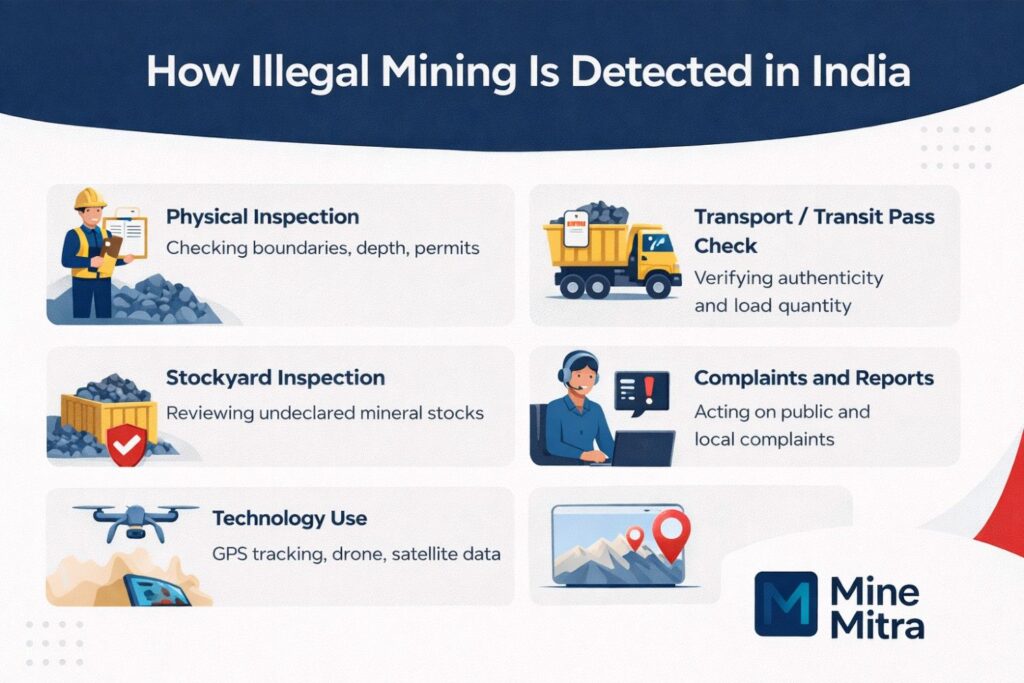
How Illegal Mining Is Detected in Practice
Detection of illegal mining is not based on one method. It involves a combination of field observation, documentation checks, and intelligence inputs.
Physical Inspection of Mining Sites
This is the most reliable method.
During inspections, officers check:
- Excavation depth and pit dimensions
- Boundary markers and lease limits
- Active vs inactive mining faces
Signs of illegal mining include:
- Fresh excavation outside permitted zones
- Machinery operating beyond approved areas
- Absence of valid permits at site
Verification of Transport and Transit Passes
Transport checks are crucial because most illegal mining surfaces during mineral movement, not excavation.
Authorities verify:
- Authenticity of transit passes
- Vehicle numbers and permit linkage
- Quantity mentioned vs actual load
Reuse or forgery of transit passes is a common violation.
Stockyard and Depot Inspection
Illegal miners often store minerals temporarily to avoid detection.
Royalty Inspectors inspect:
- Approved stockyard locations
- Quantity stored vs declared
- Source documents for stock
Unaccounted stock is treated as prima facie illegal mineral.
Complaints and Public Information
Illegal mining is frequently reported by:
- Local residents
- Environmental groups
- Competing lease holders
Complaints trigger targeted inspections, often leading to detection of violations.
Use of Technology (Limited but Growing)
Some states use:
- GPS tracking
- Drone surveys
- Satellite imagery
However, technology supports enforcement — it does not replace field verification.
Seizure Process in Illegal Mining Cases
Seizure is one of the strongest enforcement tools against illegal mining.
What can be seized?
- Illegally extracted minerals
- Vehicles used for illegal transport
- Machinery used in illegal excavation (as per rules)
Procedure for Seizure
A seizure must follow strict procedure:
- Detection of violation
- Preparation of seizure memo
- Documentation of quantity and location
- Intimation to higher authority
Failure to follow procedure can make seizure legally weak.
Custody and Release of Seized Property
After seizure:
- Property is kept in safe custody
- Offender may apply for release
- Release is subject to penalty or compounding
This process ensures revenue recovery and legal compliance.
Penalties for Illegal Mining in India
Penalties vary depending on:
- Nature of violation
- Quantity involved
- Whether offence is repeated
Monetary Penalties
Penalties may include:
- Royalty recovery
- Additional penalty amount
- Environmental compensation
In many cases, penalties are multiple times the royalty amount.
Compounding of Offences
Certain minor violations may be compounded, meaning:
- Offender pays prescribed amount
- Criminal prosecution is avoided
However:
- Compounding is discretionary
- Repeated offenders are usually not allowed compounding
Criminal Prosecution
Serious or repeated illegal mining cases may lead to:
- FIR registration
- Court proceedings
- Imprisonment and heavy fines
Criminal action is usually taken when:
- Illegal mining is organized
- Large quantities are involved
- Public safety is threatened
Why Documentation Is Critical in Illegal Mining Cases
Many illegal mining cases fail in courts not because violations did not occur, but because documentation was weak.
Strong cases require:
- Clear inspection reports
- Proper measurement records
- Valid seizure memos
- Photographic or physical evidence
This is why training and discipline of field officers matter.
Challenges Faced by Authorities in Controlling Illegal Mining
Controlling illegal mining is not only a legal issue; it is a serious administrative and governance challenge. Even with strong laws, enforcement on the ground remains difficult.
Vast and Remote Mining Areas
Mining activities often take place in:
- Remote rural regions
- Forest and riverbed areas
- Locations with poor road connectivity
Regular monitoring of such areas is logistically difficult, especially with limited staff.
Shortage of Manpower
Most states face:
- Inadequate number of Royalty Inspectors and Mining Officers
- Large jurisdictions assigned to a single officer
This makes continuous inspection and surveillance practically impossible.
Legal and Procedural Weaknesses
Offenders frequently exploit:
- Technical procedural lapses
- Jurisdictional errors
- Documentation gaps
Even when illegal mining is detected, procedural mistakes weaken the case.
Why Many Illegal Mining Cases Fail in Courts
A hard reality is that many illegal mining cases do not result in conviction. Common reasons include:
- Improper measurement records
- Weak or incomplete seizure documentation
- Delay in filing FIR or prosecution
- Lack of supporting physical or photographic evidence
Courts rely on procedural correctness, not assumptions. Therefore, only well-documented cases survive judicial scrutiny.
Environmental and Social Impact of Illegal Mining
Illegal mining causes long-term damage beyond revenue loss.
Environmental Impact
- Degradation of riverbeds
- Groundwater depletion
- Soil erosion and land instability
- Loss of biodiversity
Social Impact
- Damage to public roads and bridges
- Increased accidents and safety risks
- Conflict between local communities and authorities
These impacts justify treating illegal mining as a serious offence, not a minor violation.
Conclusion
Illegal mining in India is a complex problem involving law, administration, environment, and governance.
Although strong laws such as the MMDR Act and State Minor Mineral Rules exist, effective control depends on:
- Field-level enforcement
- Accurate documentation
- Inter-departmental coordination
Royalty Inspectors and Mining Department officials form the backbone of the enforcement system.
For aspirants and professionals, understanding illegal mining from a legal and practical perspective is essential for both examinations and real administrative roles.
Is illegal mining a criminal offence in India?
Yes. Serious or repeated illegal mining cases can attract criminal prosecution along with monetary penalties.
Can vehicles be seized in illegal mining cases?
Yes. Vehicles involved in illegal excavation or transport can be seized as per state rules.
Who usually detects illegal mining first?
In most cases, detection is done by Royalty Inspectors or Mining Department officials during field inspections.
Can illegal mining offences be compounded?
Minor offences may be compounded, but serious or repeated violations are generally not eligible.
About the Author
Navin Solanki is a Mining Engineer with over 5 years of practical experience in the Indian mining sector. He focuses on mining operations, geology, environmental studies, and regulatory topics in India. [Read More]