
Gujarat is one of India’s leading states in the extraction of minor minerals such as sand, stone, limestone, bauxite, and construction aggregates. These minerals form the backbone of infrastructure development, but they also carry a high risk of illegal mining, royalty evasion, and environmental damage.
To control these risks, the Government of Gujarat relies heavily on the Royalty Inspector.
The Royalty Inspector in Gujarat is not merely a revenue clerk or paperwork checker. In reality, this post functions as a field-level enforcement authority responsible for ensuring that mineral resources are extracted legally, royalty is paid correctly, and violations are detected at the ground level.
A weak inspection system directly results in:
- Loss of government revenue
- Uncontrolled illegal mining
- Environmental degradation
- Breakdown of regulatory authority
This is why the role of Royalty Inspector holds both administrative importance and legal responsibility. Understanding this role properly is essential not only for competitive exams but also for anyone aiming to work in the mining administration system.
Legal Framework Governing the Royalty Inspector in Gujarat
The authority of a Royalty Inspector does not arise from a single rule or notification. Instead, it is derived from a combination of central laws, state rules, and executive powers.
Understanding this framework is crucial because many exam candidates wrongly assume that Royalty Inspectors operate independently. In reality, their powers are strictly law-driven and rule-bound.
Mines and Minerals (Development and Regulation) Act, 1957 (MMDR Act)
The MMDR Act, 1957 is the foundational legislation governing minerals in India.
Key relevance to Royalty Inspector:
- Establishes government ownership over minerals
- Authorizes states to regulate minor minerals
- Provides legal backing for royalty collection
- Defines penalties for illegal mining
Although the Act is central legislation, enforcement for minor minerals is delegated to state governments, which is why Gujarat frames its own rules under this Act.
Gujarat Minor Mineral Rules (GMMR)
The Gujarat Minor Mineral Rules are the most important operational rules for a Royalty Inspector.
These rules define:
- Grant of quarry permits and leases
- Royalty rates and payment procedures
- Conditions of excavation
- Inspection powers
- Seizure and penalty mechanisms
Most field actions taken by a Royalty Inspector—such as checking permits, verifying quantities, or reporting violations are rooted in these rules.
For exam purposes, candidates must understand:
- Which actions are permitted directly
- Which actions require approval of senior officers
State Government Notifications and Circulars
In addition to Acts and Rules, executive notifications play a major role.
These notifications:
- Assign inspection jurisdiction
- Define reporting hierarchy
- Delegate seizure or verification powers
- Clarify coordination with police and revenue departments
This is why the same Royalty Inspector role may function slightly differently across districts, depending on local administrative orders.
Limited Applicability of Mines Act, 1952
The Mines Act, 1952 primarily focuses on safety, health, and working conditions in mines.
For Royalty Inspectors:
- It is not the primary governing law
- However, safety-related violations noticed during inspection may be reported to competent authorities
- Coordination with safety inspectors or DGMS may be required in certain cases
This distinction is important because Royalty Inspector is not a safety inspector, but cannot ignore serious safety violations.
Appointment Authority and Administrative Control
A Royalty Inspector in Gujarat is appointed by the State Government through the Mining & Geology Department.
Appointments are typically made through:
- State-level recruitment examinations (e.g., GSSSB)
- Departmental recruitment rules
The post is generally classified as a technical non-gazetted position, though responsibilities are highly field-oriented.
Jurisdiction of a Royalty Inspector
Jurisdiction is one of the most misunderstood aspects.
A Royalty Inspector is usually assigned:
- A specific taluka, mining circle, or district zone
- Multiple quarry sites and leases
- Transport routes and stockyards within that area
Jurisdiction is not random. It is clearly notified, and actions taken outside assigned jurisdiction may be challenged legally.
Reporting Hierarchy
A Royalty Inspector does not work independently.
The reporting chain generally includes:
- Senior Royalty Inspector / Mining Supervisor
- Geologist
- District Mining Officer
- Directorate level officers
Inspection reports, seizure memos, and violation notices are reviewed and approved as per departmental procedure.
This hierarchy ensures:
- Accountability
- Legal validity of actions
- Protection against misuse of power
Nature of the Job: Desk Work vs Field Reality
Many aspirants imagine the Royalty Inspector in gujarat role as desk-oriented. This is incorrect.
In practice, the job involves:
- Extensive field travel
- Surprise inspections
- Interaction with lease holders, transporters, and local authorities
- Physical verification of mineral extraction
Weather conditions, remote locations, and law-and-order challenges are common realities of the job.
This field-intensive nature is precisely why legal clarity and procedural correctness are essential for a Royalty Inspector.
Day-to-Day Duties of a Royalty Inspector In Gujarat (Ground-Level Reality)
The daily responsibilities of a Royalty Inspector in Gujarat are far more demanding than most aspirants imagine. This is not a routine desk job. The role requires continuous field presence, legal awareness, and procedural discipline.
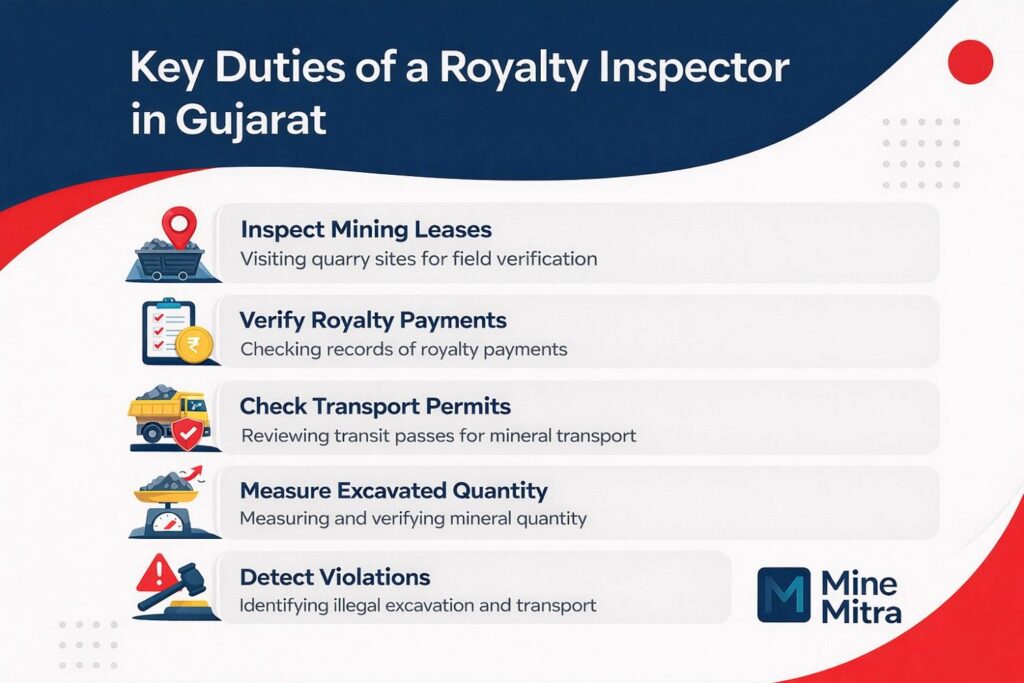
Inspection of Mining Leases and Quarry Sites
One of the primary duties is physical inspection of mining sites. During a site inspection, a Royalty Inspector verifies:
- Whether mining activity is within the approved lease area
- Whether excavation depth and boundaries are respected
- Whether mining is carried out as per permitted quantity
These inspections are often surprise visits, because advance information allows operators to manipulate records or temporarily stop illegal activity. A Royalty Inspector is expected to rely more on physical observation and measurement than on documents alone.
Verification of Permits and Lease Conditions
Every legal mining operation must operate under:
- A valid quarry permit or mining lease
- Environmental clearance conditions
- Approved mining plan
The Royalty Inspector checks:
- Validity period of permits
- Conditions attached to the permit
- Compliance with extraction limits
Failure to comply with permit conditions is treated as a serious violation, even if royalty payments appear correct.
Measurement of Excavated Mineral Quantity
This is one of the most sensitive and technical duties. Royalty is directly linked to the quantity of mineral excavated, and incorrect measurement leads to revenue loss.
Methods commonly used include:
- Volume calculation of pits
- Stack measurement at stockyards
- Cross-verification with transport records
A Royalty Inspector must be careful because:
- Minor errors can be challenged legally
- Measurement disputes are common in court cases
This is why inspection records must be clear, dated, and supported by evidence.
Checking Transit Passes and Transport Documents
Illegal transport is as common as illegal excavation. Royalty Inspectors In Gujarat routinely check:
- Transit passes
- Vehicle details
- Source and destination of minerals
Common violations include:
- Reuse of old transit passes
- Transport without permit
- Overloaded vehicles
In such cases, action is taken strictly as per the Gujarat Minor Mineral Rules, not personal discretion.
Inspection of Stockyards and Depots
Stockyards are often used to:
- Hide illegally extracted minerals
- Mix legal and illegal stock
Royalty Inspectors verify:
- Approved stockyard locations
- Quantity stored
- Matching of stock with transport and production records
Mismatch between records and physical stock is treated as prima facie evidence of violation.
Powers of Royalty Inspector In Gujarat During Inspection
The powers of a Royalty Inspector are significant but not unlimited. They are derived strictly from rules and notifications. Understanding the extent and limitation of these powers is crucial for both exams and real-world application.
Power of Entry and Inspection
A Royalty Inspector has the authority to:
- Enter mining lease areas
- Inspect stockyards and transport routes
- Conduct verification without prior notice
However, inspections must be:
- Within assigned jurisdiction
- Conducted during reasonable hours
- Properly documented
Unauthorized entry beyond jurisdiction can invalidate the inspection legally.
Power to Verify Records and Documents
During inspection, the Royalty Inspector can demand:
- Production registers
- Royalty payment receipts
- Transport permits
- Lease documents
Failure to produce records may itself constitute a violation.
Power of Seizure (Mineral and Vehicle)
One of the most misunderstood powers is seizure.
As per rules:
- Minerals extracted or transported illegally can be seized
- Vehicles used for illegal transport may also be seized
However:
- Seizure must follow prescribed procedure
- A proper seizure memo must be prepared
- Higher authority intimation is mandatory
Royalty Inspector in Gujarat does not act arbitrarily. Every seizure must stand legal scrutiny.
FIR and Police Involvement – Clarification
A common misconception is that a Royalty Inspector can directly register FIR in all cases.
In reality:
- Minor violations are handled departmentally
- Serious offences require coordination with police
- FIR is generally lodged through proper channels
This distinction is frequently asked in exams and misunderstood by aspirants.
Royalty Calculation – Practical Field Explanation
Royalty calculation is the core financial responsibility of a Royalty Inspector.
Basis of Royalty Calculation
Royalty is calculated based on:
- Type of mineral
- Approved royalty rate
- Quantity extracted
Depending on the mineral, calculation may be:
- Volume-based (cubic meters)
- Weight-based (tonnes)
Rates are notified by the state government and must be strictly followed.
Common Manipulation Practices Observed
In practice, Royalty Inspectors encounter:
- Under-reporting of excavation
- Incorrect conversion factors
- False declarations of mineral grade
For example:
- A truck carrying more mineral than declared
- Declaring waste material as low-grade mineral
Detecting such practices requires experience and field awareness, not just theoretical knowledge.
Importance of Physical Verification
Paper compliance alone is insufficient. A competent Royalty Inspector always:
- Cross-verifies physical quantity with records
- Checks consistency across permits, transport, and stock
- Identifies abnormal patterns in production
This is why the role demands technical understanding, not clerical skill.
Documentation and Reporting
Every inspection must result in proper documentation. This includes:
- Inspection reports
- Measurement records
- Violation notices
- Seizure memos (if any)
Poor documentation is one of the biggest weaknesses seen in enforcement cases and often leads to legal failure.
Common Violations Detected by Royalty Inspectors in Gujarat
A major responsibility of a Royalty Inspector in Gujarat is the detection and documentation of violations related to mineral extraction and transportation. These violations directly impact government revenue and environmental safety.
Below are the most commonly observed violations, explained with practical field context.
Illegal Excavation Without Permit
This is the most frequent violation. It involves:
- Excavation without any quarry permit or lease
- Mining after expiry of permit
- Excavation outside permitted land
Such activity is treated as illegal mining, and strict action is initiated under the Gujarat Minor Mineral Rules.
Excess Production Beyond Permitted Quantity
Even legally permitted mines often exceed approved limits. This violation occurs when:
- Excavation exceeds quantity mentioned in permit
- Mining continues beyond environmental clearance limits
Royalty Inspectors detect this through:
- Measurement discrepancies
- Transport record analysis
- Stockyard verification
Excess production attracts penalties and may lead to suspension of mining operations.
Boundary Violations
Boundary crossing is a serious offence. It involves:
- Excavation outside lease boundary
- Encroachment into government or private land
Boundary violations are usually detected using:
- Revenue maps
- GPS-based verification
- Physical boundary markers
Such violations often escalate into legal disputes.
Illegal Transportation of Minerals
Illegal transport includes:
- Movement without transit pass
- Use of fake or reused transit passes
- Overloading vehicles
Vehicles involved may be seized, and penalties are imposed as per rules.
Unauthorized Stockpiling
Minerals stored at unapproved locations are considered illegal. Royalty Inspectors verify:
- Approved stockyard location
- Quantity stored
- Source documentation
Unauthorized stockpiling often indicates illegal excavation or transport.
Coordination with Other Departments
A Royalty Inspector’s effectiveness depends on inter-departmental coordination. Key departments involved:
- Mining & Geology Department
- Revenue Department
- Police Department
- Environmental authorities
For example:
- Vehicle seizure requires police support
- Boundary verification involves revenue records
- Environmental violations are reported to competent authorities
This coordination ensures that enforcement actions are legally sustainable.
Challenges Faced by Royalty Inspectors (Ground Reality)
The role of Royalty Inspector is challenging and demanding. Common challenges include:
- Political and local pressure
- Staff shortages and large jurisdictions
- Safety risks during field inspections
- Legal challenges from offenders
- Administrative delays
Despite these challenges, integrity and adherence to law remain critical to the role.
Career Path and Promotion Structure
The Royalty Inspector in Gujarat post offers a stable career with growth opportunities. Career progression generally includes:
- Senior Royalty Inspector or equivalent roles
- Promotion to supervisory or administrative posts
- Transfers to district or state-level offices
Promotions are typically based on:
- Service record
- Departmental examinations
- Performance and integrity
Exam Relevance – Why This Topic Is Important
Understanding the Role of Royalty Inspector in Gujarat is essential for:
- GSSSB examinations
- State mining recruitment exams
- Revenue and mining-related competitive tests
Questions are often:
- Application-based
- Scenario-oriented
- Linked with legal provisions
Candidates who understand practical functioning perform better than those relying on rote learning.
Conclusion
The Royalty Inspector in Gujarat plays a vital role in protecting mineral resources, preventing illegal mining, and safeguarding government revenue.
This is a field-intensive enforcement role, requiring legal knowledge, technical understanding, and strong ethical standards. For aspirants, mastering this topic provides both exam advantage and real-world clarity.
Can a Royalty Inspector seize vehicles?
Yes, vehicles involved in illegal mining or transport can be seized following prescribed procedure.
Is Royalty Inspector a gazetted post?
Generally, it is a non-gazetted technical post under the state government.
Can a Royalty Inspector register an FIR directly?
In most cases, FIR is registered through police after due process.
Difference between Mining Inspector and Royalty Inspector?
Mining Inspector focuses on safety and compliance, while Royalty Inspector focuses on revenue protection and mineral regulation.
About the Author
Navin Solanki is a Mining Engineer with over 5 years of practical experience in the Indian mining sector. He focuses on mining operations, geology, environmental studies, and regulatory topics in India. [Read More]